



AI Funding: The Bull and Bear Investment Cases

Is AI fueling a new productivity supercycle or facing structural limits in a rapidly evolving market? Eaton Vance’s equity teams explore both views in their “Bull vs. Bear” debate.
02.12.2025 | 05:22 Uhr
In recent months, concerns have intensified that the rapid growth in artificial intelligence (AI) investment is becoming a “bubble.” This has coincided with a flurry of massive deals among the largest U.S. technology companies. The proliferation and potential implications of these deals for investors prompted the Eaton Vance (EV) equity department to conduct a “Bull vs. Bear” debate over AI funding.
The collaborative discussion, with representation from all EV equity teams, exposed both the scale of ambition driving the AI revolution and the structural risks that could constrain it. Below, we summarize the two competing narratives that emerged.
The Bull Case: A Self-Funding Productivity Supercycle
The bullish view holds that AI build-out represents the next great
wave of global industrial investment—comparable to postwar manufacturing
or the1990s internet revolution. Its deployment across health care,
education, logistics and financial services could potentially unlock
immense productivity gains.
1. Scale justifies the spend
Global corporate profits of about $5 trillion in 2025, as reported by Forbes, imply enormous reinvestment capacity.1 A mere 1% to 2% uplift in profit margins resulting from AI productivity gains could generate $1 trillion in incremental earnings—enough to justify a $10 trillion AI investment base. Proponents argue that even a small allocation, say 1% of global financial assets, could mobilize $3 trillion toward AI infrastructure without dislocating capital markets.
2. Financing capacity exists
Hyperscalers2 remain at the center of this thesis. With
potential capital expenditures of $4 trillion through 2030, an
additional $1.2 trillion in free cash flow, and as much as $2.3 trillion
in balance-sheet leverage, the combined funding power of the six
dominant cloud players could exceed $7.5 trillion.3 Other
potential sources of funding include sovereign wealth funds and debt
markets via asset-backed securities. In October, Meta raised $27 billion
in debt, structured at a 6.6% fixed rate, illustrating the maturation
of AI infrastructure financing into a relatively low-risk, quasi-utility
asset class.
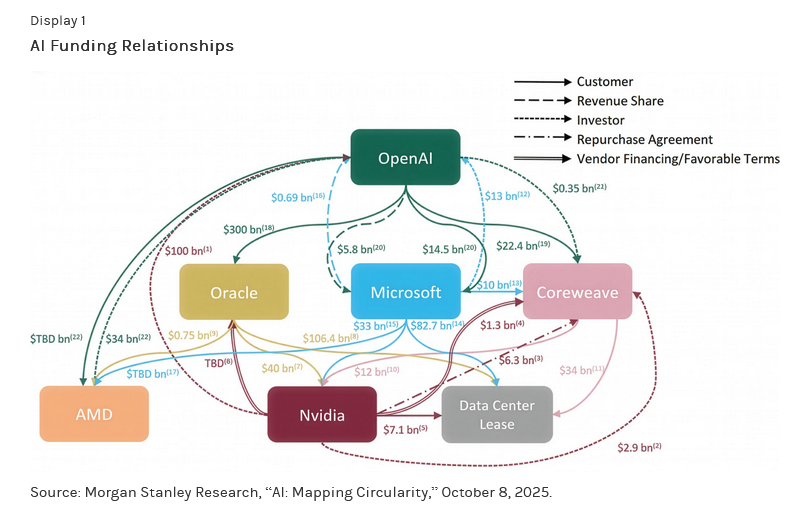
3. Circularity creates self-sustaining growth
While concerns have grown about the circularity of AI funding, as
illustrated in Display 1, the bullish view sees it as a strength:
industry leaders reinvesting profits into their ecosystems has
historically driven industrial maturity. Automotive and aerospace giants
once financed suppliers, built leasing arms, and took equity stakes in
strategic vendors. Applied to AI, this approach could mean NVIDIA or
Microsoft taking small stakes in chip foundries, data center operators
or model providers—seeding the next generation of capacity while
strengthening supply chain stability.
4. Technological and efficiency tailwinds
Finally, the bulls argue that concerns over power shortages and hardware
obsolescence will be mitigated by efficiency gains. NVIDIA reports a
40,000% improvement in their chips’ energy efficiency over time,
suggesting that compute density and performance per watt will continue
to outpace demand growth. Meanwhile, rapid improvements in model
performance may create deflationary effects, allowing AI to boost
productivity across the global economy faster than it consumes capital
or energy. In this view, AI spending becomes self-reinforcing:
productivity gains fund further investment, drawing more capital into
the ecosystem—a classic virtuous cycle.
The Bear Case: Unsustainable Leverage, Thin Revenues and Physical Limits
The bear case challenges the notion that AI’s financing machine can
run indefinitely without seeing sufficient revenues to justify the
investment. This view suggests that beneath the headline numbers, the
business models supporting the sector remain fragile, while physical and
regulatory bottlenecks loom large.
1. Fragile revenue foundations
OpenAI’s monetization dilemma is a central concern. Despite its vast
user base, only a small fraction of users pay directly, leaving revenue
concentrated in subscriptions and application programming interface
(API) fees. While some may assume adoption by businesses will close this
gap, the path to sustained free cash flow is quite uncertain. With
projections suggesting OpenAI may seek $1.6 trillion in new capital,
skeptics question whether such ambitions can coexist with a largely free
consumer model resulting in revenues of just $13 billion per year. The
risk is that a prolonged mismatch between spending and revenue could
erode balance sheets, triggering refinancing stress and equity
underperformance.
2. Leverage masks fragility
Heavy reliance on debt markets—especially structured finance—could
obscure true risk concentration. The Meta financing deal, cited by bulls
as a model of efficiency, could come to resemble the over-leveraged
telecom infrastructure of the early 2000s. If rates rise or utilization
lags, the yield advantage could quickly reverse, pressuring balance
sheets across the ecosystem.
3. Power as the hard constraint
Perhaps the most tangible risk lies in power infrastructure. Between
2028 and 2035, data centers could add a projected 15% to 20% strain on
global grids. Even with efficiency gains, power transmission,
transformer production and permitting timelines create bottlenecks that
financial engineering cannot solve. The result could be stranded
capital: data centers built faster than utilities can deliver power.
4. Governance and concentration risks
Finally, investors need to consider governance. The market’s
overreliance on visionary figures—OpenAI CEO Sam Altman foremost among
them—creates fragility in leadership and strategy. Meanwhile, the
distinction between “defensive” spending to protect existing
platforms—such as Google adding Gemini to protect its search
business—and “offensive” expansion, like Microsoft introducing and
charging more for Co-Pilot, remains blurred. This raises concerns that
much of today’s capital expenditures serve short-term competitive
positioning rather than long-term profitability.
Implications for Investors
Much of the U.S. equity market’s gains since ChatGPT’s launch in
late 2022 have been driven by companies at the center of the AI
ecosystem. As investors look to the future, a key question is whether
this powerful trend can continue or is vulnerable to a sharp pullback.
One of the key challenges is in identifying which companies can convert
AI infrastructure into recurring, high-margin revenue streams, and which
are merely relying on increasingly risky financing.
AI may indeed catalyze the next productivity supercycle. But as this debate made clear, the path from vision to value will depend less on the amount of capital that is raised—and more on how productively that capital is deployed.
Diesen Beitrag teilen: