



Crypto 101: An Introduction to Digital Assets

Digital assets are assets that exist electronically and rely on cryptographic technology and distributed networks to record ownership and transactions.
08.04.2026 | 06:38 Uhr
Most digital assets operate on blockchain technology—a shared network that records and verifies transactions in a transparent, sequential manner.¹
Unlike traditional financial systems that rely on centralized intermediaries, blockchain networks are typically maintained by a distributed group of participants who collectively validate activity on the network.¹
Blockchain Technology—In Brief
Blockchain functions as a shared network where transactions are grouped
into blocks, validated by the network and added to a continuously growing
chain. Each block links to the prior one, creating a permanent historical
record.
Key Characteristics of Blockchain Networks
- TRANSPARENCY — Transactions are publicly verifiable.
- SECURITY — Cryptography helps protect data integrity.
- IMMUTABILITY — Once recorded, transactions generally cannot be changed.
- DECENTRALIZATION — No single entity controls the network.
Why Digital Assets Are Gaining Attention
Digital assets have evolved from early experimentation toward broader
institutional awareness. Regulatory developments in major markets, improved
custody and trading infrastructure, and expanding real‑world applications have
contributed to increased investor evaluation.
Key Cryptocurrencies
BITCOIN
The first blockchain‑based digital asset, designed to enable peer‑to‑peer
transfers of value without centralized intermediaries. Bitcoin operates on its
own blockchain and has a fixed supply of 21 million units; as of early
2026, approximately 20 million (about 95%) have already been created.²
ETHEREUM
A programmable blockchain supporting smart contracts. Ethereum operates using a
proof‑of‑stake (PoS) consensus mechanism, in which network participants
validate transactions by staking tokens rather than using energy‑intensive
mining.³
SOLANA
A high‑performance blockchain network designed for speed and scalability,
emphasizing fast transaction processing and low costs. Solana supports
applications such as payments, trading and decentralized services.⁴
Comparing Major Cryptocurrencies
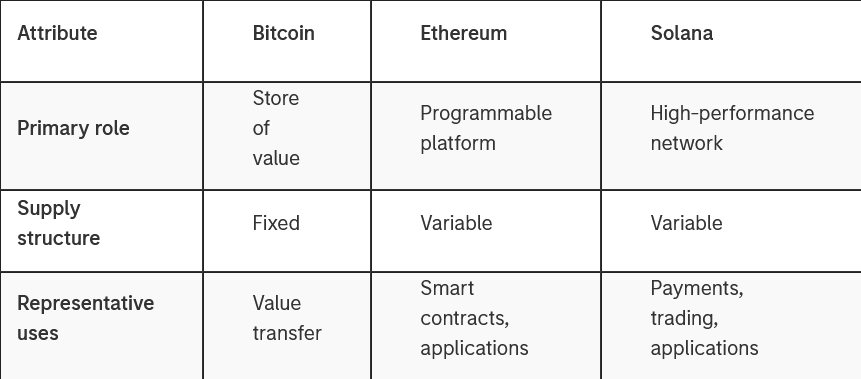
These differences can matter for investors, as factors such as network design and intended use cases influence how a digital asset is used and the types of applications it may support.
Portfolio Applications
Some investors consider digital assets appropriate for a modest
portfolio allocation, depending on individual objectives, risk tolerance
and time horizon. Interest has increased alongside regulatory developments in
several jurisdictions, growing global adoption by consumers and institutions,
and continued development of market infrastructure such as custody, trading and
settlement.
At the same time, cryptocurrencies remain volatile and are influenced by evolving regulatory, technological and market dynamics.⁵
Key Takeaway
Digital assets represent an evolving intersection of technology and
finance. Understanding blockchain fundamentals and the distinctions among major
networks can help investors more thoughtfully assess how digital assets may—or
may not—fit within a broader investment framework.
Educational material only. Not a recommendation or solicitation.
1 FINRA, Crypto Assets —
https://www.finra.org/rules-guidance/key-topics/crypto-assets
2 Bitcoin.org, Bitcoin: A Peer‑to‑Peer Electronic Cash
System — https://bitcoin.org/en/bitcoin-paper
3 Ethereum.org, Proof‑of‑Stake (PoS) —
https://ethereum.org/developers/docs/consensus-mechanisms/pos/
4 Solana, Getting Started —
https://solana.com/learn/getting-started
5 IRS, Digital Assets —
https://www.irs.gov/filing/digital-assets
RISK CONSIDERATIONS
Digital assets are highly volatile and unpredictable. Their value is
influenced by factors including supply and demand, investor confidence,
macroeconomic conditions, regulatory developments and technological change.
Prices may experience sharp fluctuations, including rapid losses. Digital
assets are not backed by any government and may be subject to fraud,
cybersecurity risks and market manipulation. Cryptocurrency investments may not
be suitable for all investors and should be evaluated in the context of individual
objectives, risk tolerance, liquidity needs and time horizon.
Blockchain is a shared, immutable ledger that facilitates the process of recording transactions and tracking assets in a business network.
Cryptocurrency (notably, Bitcoin) operates as a decentralized, peer-to-peer financial exchange and value storage that is used like money. It is not backed by any government. Federal, state or foreign governments may restrict the use and exchange of cryptocurrency. Cryptocurrency may experience very high volatility.
Diesen Beitrag teilen: