



Hedge Funds 2026 Midyear Outlook

Key Focus Remains AI and Rate Policy – „Hedge funds currently remain well positioned to navigate both interest rate policy divergence and a sustained higher for-longer rate environment.”
20.07.2026 | 04:27 Uhr
Key Reflections
In many ways, the beginning of 2026
mirrors 2025. Once again, equity markets have weathered a major
geopolitical shock, experiencing a sharp drawdown before rebounding
quickly amid shifting headlines. After falling more than 7% through late
March, the S&P 500 has since returned approximately 8.6% year to
date, reaching multiple all-time highs and demonstrating the resilience
we highlighted at year-end.1
But the cracks beneath the surface that we foreshadowed have appeared with increasing frequency. Sharp reversals in AI and technology positioning have triggered crowded unwinds and highlighted concentration risk. Meanwhile, rising bond yields have pushed stock-bond correlations higher, reducing the benefit from diversification that fixed income has traditionally provided. As markets grow more complex and the dispersion of outcomes increases, we believe hedge funds will continue to play a valuable role in investor portfolios through 2026, offering the potential to enhance returns, reduce volatility, and provide diversification regardless of the market’s ultimate direction.
What We Are Seeing
Beneath
the surface of equity markets’ resilience, AI positioning is evolving
from thematic to fundamental. Early outperformance was concentrated in
semiconductors and hyperscalers, as markets rewarded exposure to AI
infrastructure and scale. Since then, leadership has spread into memory
and power as investors increasingly distinguish between companies that
are spending on AI and those that are capable of translating that
investment into durable revenue and earnings growth. This rotation
across the AI value chain, combined with a greater emphasis on
fundamentals, is contributing to elevated dispersion, creating a rich
opportunity set for hedge fund managers.
What We Are Doing
As
the AI investment cycle evolves from an infrastructure buildout toward
greater monetization, and that this evolution spreads to more sectors,
we expect clear winners and losers to emerge. We prefer specialist
equity and credit managers who are good at analyzing and capitalizing on
these alpha opportunities, and who take a relative value, low-net or
market neutral approach with minimal beta.
We also see a compelling opportunity for event-driven strategies as capital markets activity accelerates. A resurgence of IPO issuance, highlighted by SpaceX’s blockbuster listing, as well as a robust pipeline that includes Anthropic and OpenAI, creates opportunities that extend well beyond initial allocations. Specialist event-driven managers are positioned to underwrite pre-IPO valuations and navigate post-listing volatility as secondary offerings, sell-side coverage, index-inclusion dynamics as well as lock-up expirations play out. We expect this favorable backdrop to persist through 2026.
Finally, we continue to believe that there is a constructive environment for discretionary macro managers who can continue their strong performance, capitalizing on diverging Central Bank policy, geopolitical crosscurrents, and ongoing volatility in FX, rates and commodities markets. In particular, the flexible and nimble nature of these managers should also prove useful in offering convex returns if markets experience episodic volatility.
What We Are Watching
Recent
geopolitical developments have increased the risk that inflationary
pressures will reaccelerate. In response, we are closely watching global
Central Bank policy effectiveness, its alignment with market
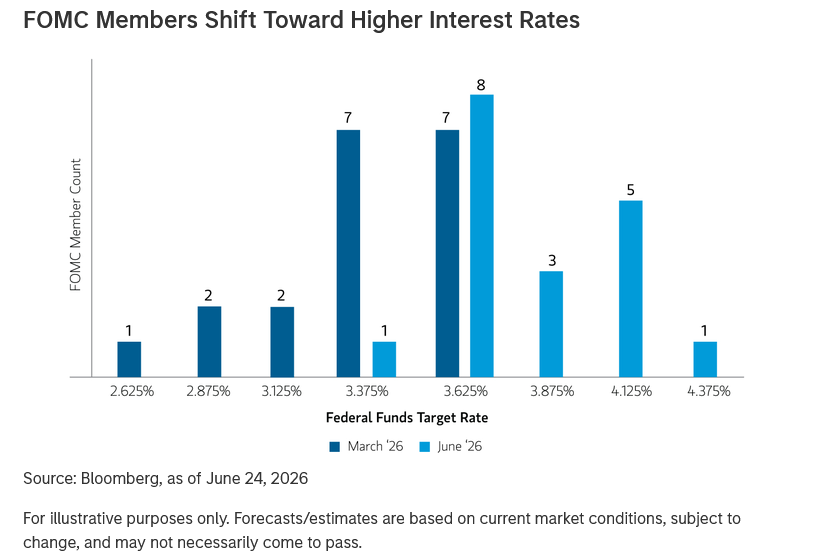
expectations and its divergence across regions. Markets entered the year
pricing-in rate cuts, but they have since shifted toward a
higher-for-longer rate outlook. In June, both the European Central Bank
and the Bank of Japan raised interest rates in response to rising
inflation, with the latter raising rates to their highest level since
1995. At the same time, we are monitoring newly appointed Fed Chair
Kevin Warsh for indications of how his approach to policy communication
and implementation may differ.
Against this backdrop, hedge funds currently remain well-positioned to navigate both interest rate policy divergence and a sustained higher-for-longer rate environment. We believe hedge funds may be able to capitalize on relative value opportunities across asset classes while delivering differentiated return streams and meaningful diversification, thereby reinforcing their role as a core component of portfolios.
1Source: Yahoo Finance. As of June 29, 2026.
Dieses Dokument ist ein Marketingdokument.
Nutzer müssen die Nutzungsbedingungen lesen und akzeptieren, da in diesen bestimmte gesetzliche und regulatorische Auflagen enthalten sind, die für die Verbreitung von Informationen zu den Anlageprodukten von Morgan Stanley Investment Management gelten.
Die auf dieser Website beschriebenen Dienstleistungen sind unter Umständen nicht in allen Rechtsgebieten oder für alle Kunden verfügbar. Weitere Einzelheiten können aus unseren Nutzungsbedingungen entnommen werden.
©2026 Morgan Stanley. Alle Rechte vorbehalten.
Diesen Beitrag teilen: