



Three Blockchains. Three ETPs. One Framework

Store of Value, Programmable Settlement, High-Speed Execution - Understanding how Bitcoin, Ethereum and Solana compare.
13.08.2026 | 05:58 Uhr
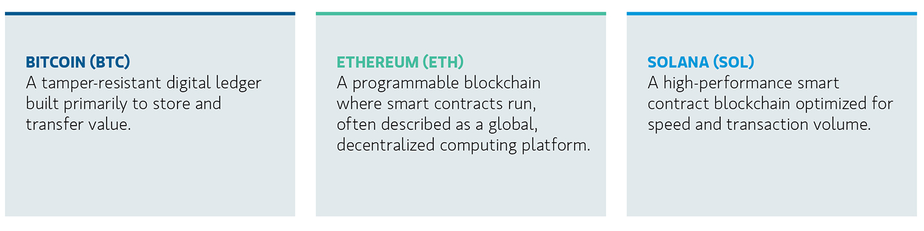
What are these three blockchains?
Bitcoin Fundamentals: Scarcity and Decentralization
Digital value transfer
What Is Bitcoin?
Bitcoin
is a cryptocurrency designed to enable peer-to-peer transfers of value
without relying on centralized intermediaries such as banks or
governments. Introduced in 2009, it operates on its own blockchain—a
shared network that records and verifies transactions.
How the Bitcoin Network Works
Bitcoin’s
blockchain functions as a decentralized ledger that records
transactions in chronological order. Transactions are grouped into
“blocks,” validated by the network using proof-of-work and added to the
blockchain at regular intervals.
Key Features
- Scarcity
Bitcoin has a fixed supply: The protocol limits total issuance to 21 million coins. New bitcoin is introduced at a predetermined pace that slows over time through block reward halving, supporting its positioning as a scarce digital asset often compared to gold. - Immutability/Decentralization
No single entity controls the network; once recorded, transactions generally cannot be altered without broad network consensus. - No Staking Yield
Because bitcoin uses proof-of-work, there is no staking or income component.
Common Use Cases
Store of value, inflation hedge, “digital gold,” sovereign reserves and peer-to-peer payments.
Who Holds It
Sovereign entities, corporate treasuries and individuals seeking a scarce, non-correlated asset.
Key Takeaway
Bitcoin’s
decentralized structure and fixed supply distinguish it from
traditional currencies and many other digital assets, reinforcing its
positioning as a simple, durable monetary asset rather than a
programmable platform.
Ethereum Fundamentals: Smart Contracts and Institutional-Grade Settlement
Programmable settlement, redefined
What Is Ethereum?
Ethereum
is a smart contract blockchain that supports decentralized applications
and digital assets through programmable code—enabling developers to
build financial applications, marketplaces and tokenized assets
on-chain.
How the Ethereum Network Works
Ethereum
processes transactions and executes smart contracts across a distributed
network of validators using proof-of-stake, where participants stake
ETH to help secure the network and validate transactions in exchange for
ETH rewards.
Key Features
- Programmability: Smart contracts allow developers to build decentralized finance (DeFi) applications, digital marketplaces and tokenized assets.
- Decentralization + security: No single entity controls the network; transactions are validated by a distributed set of participants (validators).
- Ecosystem depth: Ethereum supports one of the largest on‑chain ecosystems for DeFi, stablecoins, NFTs and tokenized assets.
- Adaptability: Ongoing network upgrades aim to improve scalability, efficiency and long‑term sustainability.
Common Use Cases
DeFi
applications (including exchanges and lending), stablecoins, tokenized
assets, NFTs/digital ownership and broader on‑chain financial activity.
Who Builds on It
Developers and institutions powering on‑chain financial infrastructure and applications.
Key Takeaway
Ethereum
is a leading smart contract blockchain that supports decentralized
financial applications, tokenization and on-chain innovation, with a
programmable design and broad ecosystem that distinguish it from
value-transfer-focused blockchains, like Bitcoin, and traditional
financial systems.
Solana Fundamentals: Speed, Throughput and “Internet Capital Markets”
High-speed execution, at scale
What Is Solana?
Solana
is a smart contract blockchain built to run applications and move
on-chain assets at scale, with a focus on high speed and low costs.
How the Solana Network Works
Solana
uses validators to verify transactions. It combines proof-of-stake with
proof-of-history (a timing system) to help order transactions and
process many at once—supporting high throughput and typically low fees.
Validators can earn SOL rewards for helping run the network.
Key Features
- Scale: Designed to support high transaction volumes without relying on layer 2 blockchains.
- Speed: Transactions are confirmed quickly, enabling near real-time settlement for many applications.
- Low costs: Transaction fees are typically minimal, supporting micro transactions and high-volume use cases.
- Programmability: Smart contracts enable developers to create decentralized finance (DeFi) tools, digital marketplaces, gaming ecosystems and tokenized assets.
Common Use Cases
Solana
is commonly associated with high‑frequency Decentralized Exchange (DEX)
trading, consumer payments, token launches, gaming, mobile‑first
applications, stablecoin settlement and prediction markets.
Who Builds on It
Developers and companies powering high-speed trading, payments and consumer applications.
Key Takeaway
Solana
emphasizes execution speed and volume, aiming to support market-like
activity and consumer applications where latency and fees matter.
Side-by-Side Summary: The Differences That Matter
Comparison framework
Dieses Dokument ist ein Marketingdokument.
Nutzer müssen die Nutzungsbedingungen lesen und akzeptieren, da in diesen bestimmte gesetzliche und regulatorische Auflagen enthalten sind, die für die Verbreitung von Informationen zu den Anlageprodukten von Morgan Stanley Investment Management gelten.
Die auf dieser Website beschriebenen Dienstleistungen sind unter Umständen nicht in allen Rechtsgebieten oder für alle Kunden verfügbar. Weitere Einzelheiten können aus unseren Nutzungsbedingungen entnommen werden.
©2026 Morgan Stanley. Alle Rechte vorbehalten.
Diesen Beitrag teilen: