



Why Quality Stocks Still Matter in Today’s Market

After several years of lagging market leadership, quality-oriented equities may offer an attractive entry point for long-term investors.
27.07.2026 | 05:39 Uhr
Historically, companies with durable business models, strong returns on capital, disciplined capital allocation and resilient competitive positions have generated disproportionate shareholder value over time (Display 2). Their ability to create sustainable cash flows and compound earnings across market cycles has been a key driver of that long-term performance, while potentially providing resilience during periods of economic stress.
Yet quality-oriented factors have been notably out of favor in recent years. Market leadership has become increasingly concentrated in companies tied to artificial intelligence, digital infrastructure and other high-growth themes. As investors have prioritized future growth potential, traditional measures of quality, such as profitability and balance-sheet strength, have played a diminished role in market leadership. Recent factor behavior illustrates the extent of this divergence.
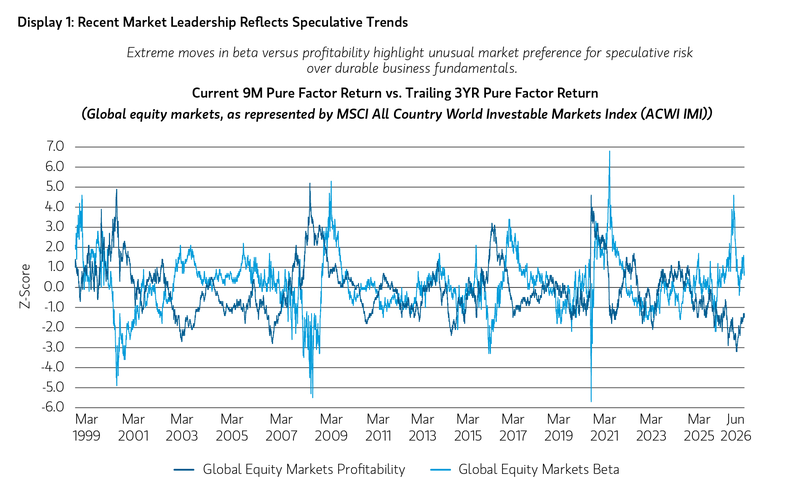
The Z score is representative of returns. It is a statistical measurement that describes a value’s relationship to the mean of a group cohorts. Z score is measured in terms of standard deviations from the mean. Profitability is a composite of four equal-weighted descriptors designed to measure how efficiently a firm’s operations generate profits. Beta explains common variations in stock returns due to different stock sensitivities to market systemic risk that cannot be explained by the World factor. World factor is from FactSet and the market beta used in our risk models.
Source: FactSet, Barra as of April 16, 2026. Data provided for informational purposes only. Past performance is no guarantee of future returns. It is not possible to invest directly in an index.
In global equity markets, investor risk appetite reached unusually elevated levels during the recent market cycle, from Q1 2025 to present, while profitability-oriented factors experienced historically weak performance. This divergence reflects an environment in which investors increasingly prioritized future growth expectations over current profitability and business durability.
Periods like this are not unprecedented. Market history is filled with episodes in which investor enthusiasm temporarily outweighs business fundamentals. During these periods, quality investing can appear frustratingly out of sync with prevailing market leadership. Over time, however, fundamentals have consistently reasserted themselves.
The reason is straightforward: business fundamentals matter. Companies that generate sustainable free cash flow, maintain strong competitive positions and allocate capital effectively are generally better equipped to navigate economic uncertainty, changing competitive dynamics and periods of market volatility. Empirical evidence across developed equity markets, shown in Display 2, supports this view.
Long-term evidence
We
have found that companies within the MSCI World Index that combine high
sales growth, strong margins and attractive returns on invested capital
consistently outperformed over multiyear periods. Notably, these
companies also tended to exhibit lower volatility than many
lower-quality peers, highlighting the potential benefits of quality
across both return and risk dimensions.
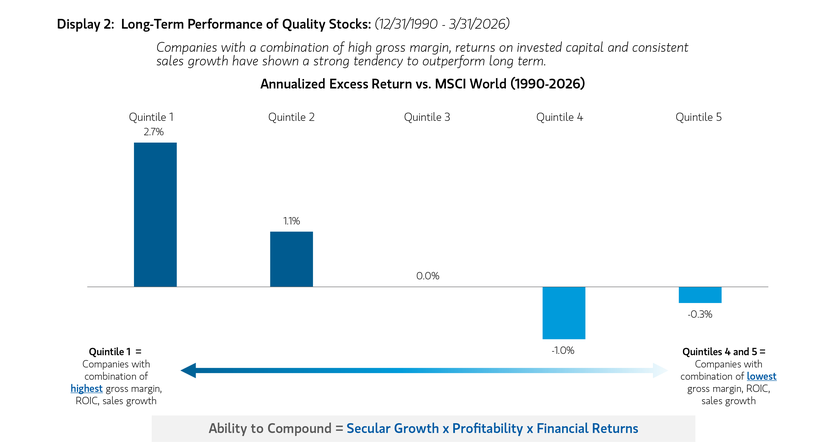
Source: Eaton Vance, FactSet and Barra. As of 3/31/2026. Study ran for the period of 12/31/1990 to 3/31/2026, based on the holdings in the MSCI World Index. The MSCI World Index was broken into 5 quintiles, defined by equally weighted factors (sales growth, gross margin and return on invested capital (ROIC). Quintile 1 was populated with companies demonstrating the highest combination of sales growth, gross margin and ROIC, while Quintile 5 represented companies with the lowest combination. These quintile groupings were held for 5 years. A new quintile grouping was created every subsequent month and held for 5 years. The quintiles in the above graph represent the market-weighted excess return of the combined groupings for each quintile over the full time period. Past performance is no guarantee of future returns. It is not possible to invest directly in an index.
Why quality may be attractive today
The case for quality
may become even stronger in the years ahead. A higher cost-of-capital
environment, increasing geopolitical uncertainty, and greater economic
fragmentation may create advantages for businesses with strong balance
sheets, pricing power, and the ability to fund growth internally. At the
same time, recent market dynamics have created an unusual valuation
backdrop. While investors historically have been willing to pay premium
valuations for quality businesses, many now trade at more reasonable
valuations, despite improving fundamentals.
As profitability has improved across portions of the quality universe, relative valuations have compressed. The result is a potentially compelling combination of stronger business fundamentals and lower relative expectations. In some areas of the market, high-quality businesses appear unusually inexpensive relative to their long-term earnings power and competitive strength.
The investment case for quality therefore extends beyond the enduring strengths of these businesses. It also reflects the possibility that today’s market offers an attractive entry point into quality companies, as improving fundamentals have not been fully recognized in valuations.
Conclusion
In our view, it’s
clear that while quality investing may remain challenged over shorter
periods, the underlying principles remain intact. Decades of empirical
evidence suggest to us that businesses with durable competitive
advantages and strong fundamentals have consistently created value over
time.
We believe successful, long-term investing is not about chasing the strongest 12-month performance trend. It is about owning businesses capable of creating value across a full market cycle and maintaining conviction when market leadership shifts.
Innovation matters. Narratives matter. But over the long term, business fundamentals matter most.
Risk Considerations:
The value of investments held by the
Strategy may increase or decrease in response to economic, and financial
events (whether real, expected or perceived) in the U.S. and global
markets. The value of equity securities is sensitive to stock market
volatility. Investing primarily in responsible investments carries the
risk that, under certain market conditions, the Strategy may
underperform funds that do not utilize a responsible investment
strategy. The Strategy is exposed to liquidity risk when trading volume,
lack of a market maker or trading partner, large position size, market
conditions, or legal restrictions impair its ability to sell particular
investments or to sell them at advantageous market prices. The impact of
the coronavirus on global markets could last for an extended period and
could adversely affect the Strategy’s performance.
The views and opinions and/or analysis expressed are those of the author or the investment team as of the date of preparation of this material and are subject to change at any time without notice due to market or economic conditions and may not necessarily come to pass. Furthermore, the views will not be updated or otherwise revised to reflect information that subsequently becomes available or circumstances existing, or changes occurring, after the date of publication. The views expressed do not reflect the opinions of all investment personnel at Morgan Stanley Investment Management (MSIM) and its subsidiaries and affiliates (collectively “the Firm”) and may not be reflected in all the strategies and products that the Firm offers.
Forecasts and/or estimates provided herein are subject to change and may not actually come to pass. Information regarding expected market returns and market outlooks is based on the research, analysis and opinions of the authors or the investment team. These conclusions are speculative in nature, may not come to pass and are not intended to predict the future performance of any specific strategy or product the Firm offers. Future results may differ significantly depending on factors such as changes in securities or financial markets or general economic conditions.
Diesen Beitrag teilen: